| Construction |
| Floor plans |
| 3D Renderings |
| About AB Design |
| About Barber Builders |
| About McFadden Design Group |
| About Ashely & Vance |
| Frequently Asked Questions |
| Project | HO:ME 296 |
| Architecture | AB Design |
| Builder | Barber Builders, Steelblox |
| Interior Design | McFadden Design Group |
| Landscape Architect | Greens Landscape |
| Structural and Civil Engineer | Ashely & Vance |
| Electrical Engineer | JMPE |
| Area | 2,435 SF |
| Bedrooms | 3 |
| Containers | 4x40ft, 1x20ft |
| Location | Santa Barbara, California |
| Year | 2017 |
Description from architects:
How did the architects create a luxury, single-family container-based residence in Santa Barbara County that infused the owners’ distinct personalities?
Schulte Lane captures the essence of AB design studio’s ethos of “inspiration through collaboration.” From concept to completion, the studio strategically maintained a collaborative relationship with key stakeholders at every level to realize this high-end, container-based dwelling in Santa Barbara County—the first of its kind to be permitted in the area.
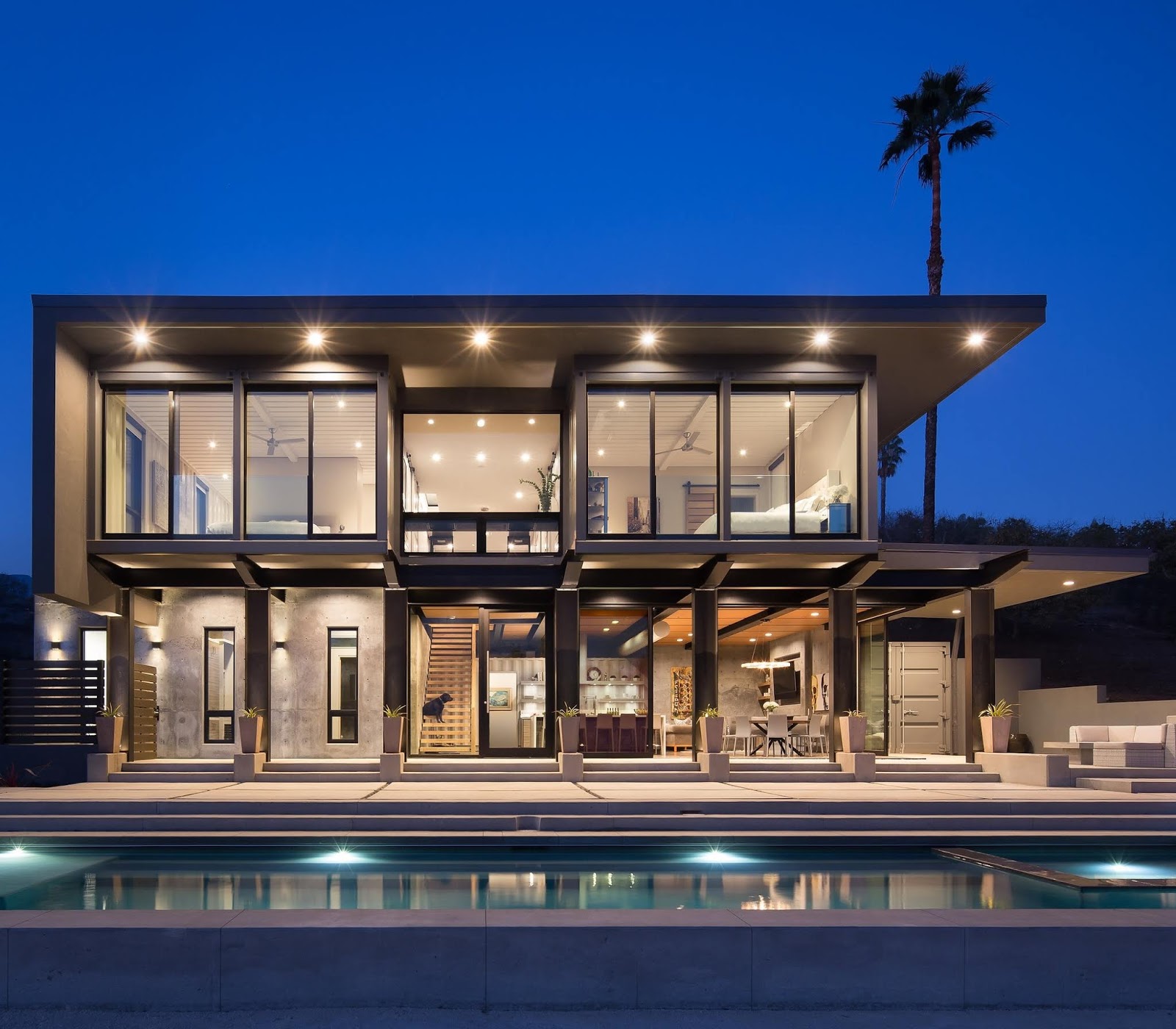
Entrusting AB design studio with their vision, the owners—an environmental attorney and a fashion stylist—wanted a sustainable and elegant contemporary home that complemented their personalities and occupational passions. The result is a two-story residence, seamlessly integrating five reclaimed shipping containers, nestled into the lush Santa Barbara hillside. The upper level consists of four 40-foot containers that form the master suite and bedroom spaces, separated by a dramatic central stairwell and corridor with skylight. On an open first floor plan, the architects combined living spaces and kitchen to create a center of activity and area for entertaining. The space’s main focal point is an exposed 20-foot shipping container that was transformed into a pantry and scullery.

AB design studio worked closely with Barber Builders to ensure a timely construction process, and with Greens Landscape, Inc. to create a drought-tolerant landscape. The architects incorporated green strategies, such as photovoltaic and bio-retention systems, along with high life-cycle materials, including concrete and structural steel. Together with McFadden Design Group, the studio balanced the rawness evoked by eco-conscious elements against highly refined interior spaces featuring weathered oak-stained wood, minimalist finishes, and modern fixtures. Blurring the line between indoor/outdoor spaces is an expansive floor-to-ceiling, folding glass door system that opens up to showcase unobstructed views of an 85-foot swimming pool and sweeping canyon vista.

Description from SteelBlox - Builder
- Understood the vision
- Respected timelines and budgets
- Could deliver a phenomenal home


Description from Barber Builders
The Client
Barber Builders built my dream home out of shipping containers! The work ethic and attention to detail exceeded my expectations. Don is an artist and demands perfection. He builds to his own high standards.
Bret Stone - Homeowner
The Journey
A newly found labor of love, Don and his team came to embrace the challenges of using Shipping Containers as a unique and powerful building material to help the Stone's realize a truly dramatic result. All while maintaining a highly energy efficient "green" built structure.
Don attributes the end result to the level of effort put into early stage details. From understanding the Shipping Container and its native qualities, to pushing back on structural requirements that did not enhance the building process or efficiencies intended. The process was a true learning experience for our entire team.
"We left this project fully equipped with a new set of educational tools that will enhance our firm for many years to come."
The Team
A fantastic team of dedicated professionals helped to bring our project together. The vision, dedication and commitment made all the difference in making our dream shipping container home in California a reality.


Two-Story Shipping Container Home Construction, California
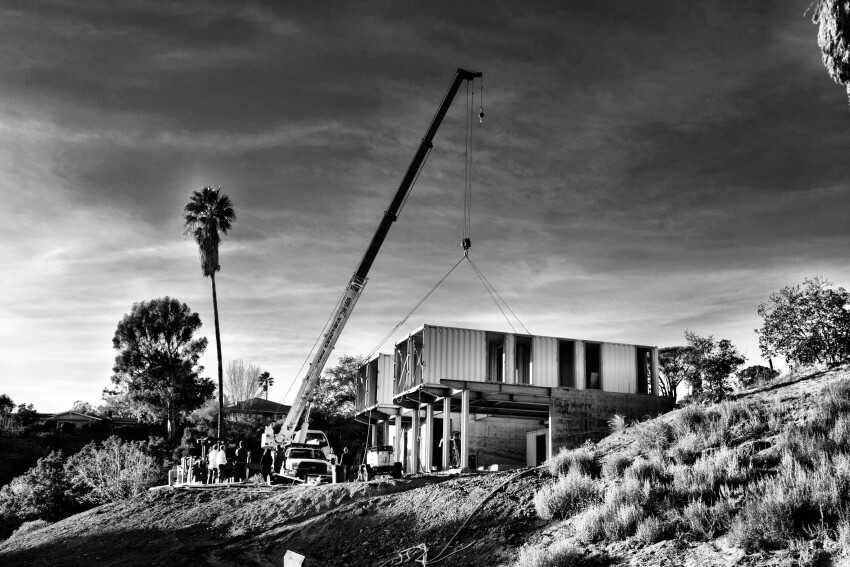
New 2,435 sf two-story single family dwelling constructed with architectural concrete, steel and (5) ISBU shipping containers. (4) 40’ containers make up the majority of the 2nd floor creating a Master Suite comprised of (2) containers connected via a breezeway to two additional rooms comprised of (2) more 40’ containers. The fifth container is a 20’ ISBU and is located in the lower level great room serving as a pantry / storage area behind the kitchen. The southern facade is all glass that opens up to the patio and the view through the canyon. The home is built into the hillside and steps down to the patio and pool area below.




| LOT SIZE | 96,270 SF |
| PRINCIPAL | Josh Blumer, AIA |
| PROJECT MANAGER | Paul Rupp, AIA |
| DESIGN TEAM | Clay Aurell, AIA | Josh Blumer, AIA | Robert Pester |
| INTERIOR DESIGNER | McFadden Design Group |
| GENERAL CONTRACTOR | Barber Builders |
| LANDSCAPE ARCHITECT | Greens Landscape, Inc. |
| STRUCTURAL ENGINEER | Ashley & Vance |
| CIVIL ENGINEER | Ashley & Vance |
| ELECTRICAL ENGINEER | JMPE |
| TITLE 24 | Inger Associates |
3 Bedroom Shipping Container Home Floor Plans, California


Two-Story Four 40ft and One 20ft Shipping Container Home 3D Renderings, California


About AB Design (California)
AB design studio transforms ideas and concepts for living into beautiful shipping container homes and buildings, spaces and experiences. Every aspect of design is thoughtfully executed with passion and attention to detail using an interdisciplinary approach based in the principles of ENVD, environmental design. We bring a modern understanding of architecture with an appreciation for a variety of architectural styles. Utilizing innovative techniques and thoughtful use of materials we explore the potential of each design in order to translate it into practical, responsible and buildable projects like this shipping container home in California. Each project comes with its own set of opportunities, obstacles and considerations; to this we bring intentionality, experience and creativity.
AB design studio strives to unleash explorative context-based designs that allow us to creatively re-assess what a built environment can provide for its users and the future. We value creativity and a rigorous process of problem solving. ABds believes that creativity reaches well beyond the arts to affect disciplines in various industries. Problem solving isn't an ability, it's a mindset that drives people to proactively shape their environments. We believe that good design is good business.
Seeing is believing. We believe successful solutions are communicative, tangible and visible. AB design studio brings our projects to life using our unique visualization process. In addition to informing the assumptions in our design, this process produces highly creative and innovative concepts that emerge quickly and efficiently. The end result is a clear picture providing valuable project information that the project team and client can use to present and realize the design with local agencies, decision makers, consultants and builders.
| Address in Santa Barbara, CA: 420 E HALEY ST SANTA BARBARA, CA 93101 | |
| Phone: 8059632100 | |
| FB: facebook.com/ABDesignStudioInc/ | |
| Twitter: twitter.com/ABdesignstudio | |
| Instagram: instagram.com/abdesignstudio/ | |
| Pinterest: pinterest.com/abdesignstudio/ | |
| Email: info@abdesignstudioinc.com | |
| Website: https://www.abdesignstudioinc.com/ | |
| Address in Los Angeles, CA: 2234 BARRY AVE STE 100 LOS ANGELES, CA 90064 |
About Barber Builders (California)
Don Barber, President & Founder of Barber Builders
Living and working on the Central Coast of California for more than 30 years, Don has set Barber Builders apart with a simple hard work approach to getting things done. Shipping container home in Santa Barbara, California, has become a good example of quality work.
"My entire career has been about taking care of my clients needs with care and respect. I can't imagine doing it any other way. We're looking for great new challenges, and opportunities to grow our community with trust, care, and faith."
We appreciate the challenges of the day, and take them head on. Our crews are prompt and dedicated to the tasks at hand. We are goal oriented and work hard to keep timelines and budgets in good order.
Do the job, and do it right. Its a simple mantra, but it keeps our crews focused on success and delivering our clients out of this world results and this amazing shipping container home in California is a great example. Going the extra mile is just part of the race, and our clients should expect nothing less.
There are many choices in the marketplace, and when you choose Barber Builders for your project, it is greatly appreciated. We earn your business by building trust and delivering on our word. It has served us well over the years, and we think its the only way to grow a solid business in such an intimate community. Our clients become our best evangelists, as they share the journeys we've taken together.
| Address | 809 Northpointe Place, Lompoc, CA 93436 | |
| Mailing Address | P.O. Box 723, Lompoc, CA 93438 | |
| Phone 1 | +18057357503 | |
| Phone 2 | +18058969648 | |
| FB | https://www.facebook.com/barberbuilders | |
| Houzz | houzz.com/pro/barberbuilders/barber-builders | |
| Email 1 | info@barberbuilders.com | |
| Email 2 | accounting@barberbuilders.com | |
| Email 3 | admin@barberbuilders.com | |
| Website | https://www.barberbuilders.com/ |
About McFadden Design Group (California)
In the beautiful interior and decor elements of this incredible shipping container home in California we can see results of hard work of McFadden Design Group.
Transforming spaces has been a part of my life from a very early age . As a child I would constantly rearrange my parent’s living room until I felt it was ‘just right’. Even down to the smallest detail, I knew how a room made me feel when I entered it. My spatial and visual persistence eventually manifested itself into a career in design.
I began working in the art department of a Los Angeles production company where I designed and created sets, stages and vignettes for commercials, film and television. The demands of production meant quick turnarounds, strict budgets and client collaborations; all invaluable experiences I apply to my business today.
I later worked as a freelance stylist for a global retailer on their catalogs, books and magazines. This allowed me to travel to unique locations absorbing the different cultures where I learned to be creative with limited resources while creating settings layered with texture, history and locally sourced products.
Shortly after our first child was born, my husband and I returned to our hometown of Santa Barbara, CA where I launched McFadden Design Group. Here I have been fortunate to create a successful design/build business in both the residential and commercial fields.
Designing for restaurants and nightclubs provides me the freedom to push the boundaries of public spaces and draw from my experience with set design. Designing homes, including prefab homes and shipping container homes allows me to intimately collaborate with my client to create an atmosphere that reflects our combined vision.
I am currently in the pre-production stages of an eponymous textile line with plans to expand into home décor and a private label furniture line. Many of my clients have bespoke furniture designed by MDG studio.
When I am not working in design, you will find me working with my family's foundation, DJEMF and our herd of rescued and retired Thoroughbred racehorses. djemf.com
This shipping container home in California has become another indicator of a high level of design.
| Address | 3132 Argonne Cir, Santa Barbara, CA 93105, United States | |
| Phone | +1 805-448-0566 | |
| sjmcfadden@mac.com | ||
| Website | https://www.mcfaddendesigngroup.com/ |
About Ashely & Vance
At Ashley & Vance Engineering, we value the building process – from plans, calculations and infrastructure to enduring relationships with people. Ashley & Vance Engineering is a civil and structural engineering firm that offers cost-conscious, practical and creative solutions, including solutions for shipping container homes for clients in California and all over the West. Our greatest desire is that our influence in each and every project is quality, creativity, and above all, integrity.
Valued as the firm’s greatest asset, our team is not only highly qualified, but they are ethical, talented people with strong leadership skills and deep-rooted community values. We have team members working in offices all over the United States, including California, Colorado, Nevada, Washington, and Oregon, and we have been able to bridge the gaps traditionally posed by distance by fully embracing the benefits of technology for construction of prefabricated structures and modular shipping container homes.
Established in 2005, Truitt Vance originally founded the company out of his house, and later when Charles Ashley brought his expertise to the company, their mission was simple: to collaborate and to allow their construction experience to inform their design philosophies. Throughout the years and evolution of the company, our values have not changed. We continue to believe in practical, smart designs and we place great emphasis on our relationships both within the firm and with our clientele.
As we expanded to accommodate the burgeoning construction scene of the early 2000’s, we sought out skilled, knowledgeable engineers to join our team and maintain our mission of providing cost-effective and buildable engineering designs for various types of structures, including modular homes and shipping container homes in California. When the economy stalled in 2008, the business climate provided us an excellent opportunity to distill our company values and forge tight bonds within our firm. With every single employee still in place, we established company-wide traditions that would become integral in Ashley & Vance’s company culture. When the market started to turn more favorably, our team looked to future challenges with confidence, competence, and solidarity.
Civil Engineering
The civil group spans a wide spectrum of services that provide public and environmental benefits to many areas within our communities. We strive to come up with creative solutions that allow our clients to participate in the process of project development. It is our philosophy that we can provide the best service possible when we collaborate with all the team members.
- Hydraulic Modeling
- Wastewater Stormwater
- Water Systems
- Low Impact Development (LID)
- Grading & Drainage Plans
- Public Right of Way Improvements Environmental Protection Plans
Creative, & economical solutions for a wide range of challenging projects:
The company has excellent examples of commercial construction, shipping container residential, industrial, institutional, public works, and renewable energy projects. These projects show how diversified our experience is for a large range of challenging work throughout the United States.
Strong Permitting Experience:
Federal, State, and local agency permitting experience in multiple jurisdictions throughout the western United States, shipping container homes permitting in California.
We also develop Preservation, Mitigation, and Enhancement (PME) plans for a variety of applications including, Stormwater Pollution Prevention Plans (SWPPP), Erosion Control Plans, Hydraulic Studies, and CA Regional Water Board SMARTS System Compliance.
Structural Engineering
Our experienced staff is capable of providing structural engineering services throughout the United States. We are dedicated to efficient cost conscious solutions and we are confident our team has the capabilities necessary to complete your project.
We have the technical ability and experience necessary for your project whether it is an addition to your home, new custom home, shipping container home, commercial building, bridge, hospital, school, wastewater treatment plant, and everything in between.
- Seismic Retrofits
- Post Tensioned Concrete
- High Lift Masonry
- Tilt-up Concrete
- Steel Moment Frame
- Gluelaminated Timber
- Composite Reinforced Concrete
- Precast
Creative, & economical solutions for a wide range of challenging projects:
The company has excellent examples of commercial construction, residential, industrial, shipping container projects, institutional, public works, and renewable energy projects. These projects show how diversified our experience is for a large range of challenging work throughout the United States.
Structural permitting experience including shipping container homes permitting in California:
- California Division of the State Architect (DSA)
- County and City Building Departments
- HCAI - Department of Health Care Access and Information (former California Office of Statewide Healthcare Planning Development - OSHPD)
- Army Corp of Engineers
- California Construction Authority
- United States Bureau of Reclamation
-
FERC - Federal Energy Regulatory Commission
- City of Seattle
Construction Engineering
Our staff provides for shipping container homes construction administration services that includes onsite quality control, and on-site inspection for shipping container homes.
Additionally we provide services to contractors for construction plans requiring professional engineering design and approval. We provide value engineering for shipping container homes by collaboratively working with contractors and owners on many types of projects saving the owner money, and providing a better project.
Contractor Construction Plans:
- Shoring
- Pile
- Crane Pads
- Retaining Walls
- Pipe Design
- Thrust Blocks
- Dewatering
- Retrofits
- 3D CAD modeling
- Value Engineering
- Temporary Erosion Control Plans
- Stormwater Pollution Prevention Plans (SWPPP)
| Toll Free | (800) 549-8486 |
| info@ashleyvance.com | |
| Website | https://ashleyvance.com/ |
Bend, Oregon | |
| Address | 33 NW Franklin Avenue, Suite 110, Bend, Oregon, 97703 |
| Phone | +1 541 647-1445 |
Reno, Nevada | |
| Address | 7530 Longley Lane, Suite 105, Reno, Nevada, 89511 |
| Phone | +1 775 825-4945 |
Arvada, Colorado | |
| Address | 9555 Ralston Road, Unit 201, Arvada, Colorado, 80002 |
| Phone | +1 303 755-9762 |
Rocklin, California — Sacramento Office | |
| Address | 6960 Destiny Drive, Suite 109, Rocklin, California, 95677 |
| Phone | +1 916 790-3181 |
Pasadena, California — Los Angeles Office | |
| Address | 600 S. Lake Avenue, Suite 308, Pasadena, California, 91106 |
| Phone | +1 323 744-0010 |
San Luis Obispo, California | |
| Address | 1229 Carmel Street, San Luis Obispo, California, 93401 |
| Phone | +1 805 545-0010 |
Oakland, California | |
| Address | 1729B Telegraph Avenue, Oakland, California, 94612 |
| Phone | +1 510 473-2221 |
Santa Barbara, California | |
| Address | 210 E. Cota Street, Santa Barbara, 93101 |
| Phone | +1 805 962-9966 |
Frequently Asked Questions About the HO:ME 296 Shipping Container Home
1. What is the HO:ME 296 shipping container home?
HO:ME 296 is a contemporary two-story residence in Santa Barbara, California, constructed using five reclaimed shipping containers. Designed by AB Design Studio and built by Barber Builders and Steelblox, the home combines industrial materials with sophisticated architecture, comfortable interiors, and sustainable building strategies.
2. How many shipping containers were used to build this house?
The house incorporates five shipping containers: four 40-foot containers and one 20-foot container. The four larger containers form the majority of the upper floor, while the smaller container is integrated into the ground-floor living area as a pantry and scullery.
3. How large is the HO:ME 296 container house?
The residence has approximately 2,435 square feet of interior living space and includes three bedrooms. Its two-story configuration creates a clear separation between private sleeping areas and shared living spaces.
4. How is the interior space organized?
The upper floor contains the primary suite and additional bedrooms, arranged around a central stairwell and corridor with a skylight. The ground floor features an open-plan kitchen and living area designed for entertaining. An exposed 20-foot container serves as a distinctive pantry and storage space.
5. How much does it cost to build a luxury shipping container home in Santa Barbara?
The cost depends on the number of containers, architectural complexity, land conditions, engineering, finishes, and local permitting requirements. Broad estimates for high-end custom container homes between 1,500 and 3,000 square feet range from approximately $400,000 to $800,000 or more. Premium materials, hillside construction, swimming pools, and extensive glazing can increase the investment considerably.
6. Are shipping container homes cheaper than traditional houses?
They can offer savings through modular construction, efficient material use, and reduced on-site assembly time. However, container homes are not automatically less expensive than conventional houses. Structural reinforcement, insulation, foundations, transportation, utilities, architectural design, and regulatory compliance can substantially affect the final budget.
7. What permits are required to build a shipping container home in Santa Barbara?
A container home must satisfy applicable residential zoning regulations, building codes, structural requirements, and local planning rules. Depending on the property, approvals may involve grading, drainage, fire safety, environmental protection, and coastal development. Requirements should be confirmed with the relevant City of Santa Barbara or Santa Barbara County authorities before construction begins.
8. Can shipping container homes be built in coastal areas of California?
Yes, provided the proposed development satisfies applicable coastal regulations and local building requirements. Properties within designated coastal zones may require additional review concerning visual impact, environmental preservation, drainage, access, and land use. A Coastal Development Permit may also be necessary.
9. Are shipping container homes structurally safe, especially in earthquake-prone regions?
They can be engineered to meet applicable structural and seismic requirements. However, cutting openings for windows, doors, and connecting spaces can affect the original strength of the steel containers. Professional structural engineers must evaluate the modifications and design appropriate reinforcement, connections, foundations, and lateral resistance systems.
10. What type of foundation is needed for a two-story container house?
The foundation depends on soil conditions, building weight, topography, seismic design, and local engineering requirements. Possible solutions include reinforced concrete slabs, concrete footings, and engineered pier systems. On hillside properties, additional retaining structures, soil stabilization, and drainage measures may be necessary.
11. How are shipping container homes insulated and ventilated?
Steel containers require carefully designed insulation and moisture control because metal conducts heat and can develop condensation. Depending on the climate and building assembly, solutions may include closed-cell spray foam, rigid insulation, thermal breaks, vapor-control layers, and mechanical ventilation. Properly designed heating and cooling systems help maintain comfortable indoor temperatures throughout the year.
12. Are shipping container homes energy-efficient and environmentally friendly?
They can incorporate several sustainable design strategies, including reclaimed steel structures, photovoltaic panels, high-performance windows, efficient HVAC systems, and water-conscious landscaping. HO:ME 296 incorporates photovoltaic and bioretention systems, as well as durable materials selected with long-term performance in mind. Its overall environmental impact depends on material sourcing, energy consumption, construction methods, and building lifespan.
13. How long does it take to construct a multi-container home?
The schedule varies according to architectural design, permitting, site preparation, fabrication, transportation, and finishing requirements. The HO:ME 296 project took approximately 12 months to take shape. Its construction team coordinated site work, foundation preparation, utility connections, and steel fabrication to help streamline the process.
14. What are the biggest challenges when building a shipping container home?
Common challenges include obtaining permits, engineering structural modifications, managing insulation and condensation, transporting containers, and coordinating specialized contractors. Hillside properties and coastal locations can introduce additional complications involving soil stability, drainage, fire safety, and environmental regulations. Early collaboration between architects, engineers, and builders is essential.
15. How can shipping container homes be protected against corrosion?
Containers should be inspected for existing rust, damaged coatings, and moisture exposure before construction. Protective systems may include corrosion-resistant primers, appropriate marine-grade coatings, sealed connections, and effective drainage. In coastal environments such as Santa Barbara, regular inspections and maintenance are particularly important because salt-laden air can accelerate corrosion.
16. Can a shipping container home include large windows and indoor-outdoor living spaces?
Absolutely. Structural modifications allow architects to incorporate expansive glazing, folding glass doors, terraces, and open-plan interiors. In HO:ME 296, floor-to-ceiling folding glass doors connect the main living area with the outdoor patio, swimming pool, and surrounding canyon landscape. Such openings require carefully engineered steel reinforcement.
17. Can shipping container homes be financed with conventional mortgages?
Financing is possible, but some traditional mortgage lenders may be reluctant to finance unconventional construction. Depending on the project and lender, potential options include construction-to-permanent loans, portfolio mortgages, specialized construction financing, and private lending. Borrowers should discuss the property's construction type and appraisal requirements with lenders before purchasing land or beginning construction.
18. Can a shipping container home be used as an accessory dwelling unit (ADU)?
Yes. A properly designed and permitted container structure can potentially serve as an accessory dwelling unit, guest house, or secondary residence. Approval depends on local zoning, property conditions, building codes, utility connections, and applicable ADU regulations. Financing options may include specialized ADU loans or qualifying home equity financing.
19. Is a shipping container home a good long-term investment?
A well-designed and professionally constructed container home can offer lasting residential value, particularly when it combines architectural quality, energy efficiency, desirable location, and durable materials. However, resale value depends on local market conditions, permitting documentation, construction quality, insurance availability, and buyer demand. Potential rental income must also comply with applicable local regulations.
20. Which professionals should be involved in building a luxury shipping container home?
A successful project requires collaboration between several specialists, including:
- Architects: Develop the overall design, spatial organization, and relationship between the home and its surroundings.
- Structural engineers: Design foundations, steel reinforcements, container connections, and seismic resistance.
- General contractors: Coordinate construction schedules, subcontractors, materials, and quality control.
- Interior designers: Create functional, cohesive interiors that balance industrial elements with residential comfort.
- Civil engineers: Address grading, drainage, utilities, and site infrastructure.
- Landscape architects: Integrate outdoor living areas, sustainable planting, and stormwater management.
HO:ME 296 demonstrates how close cooperation between these professionals can transform reclaimed shipping containers into a refined, functional, and architecturally distinctive family residence.
RESOURCES
1. Where can I find general information on shipping container homes in Santa Barbara?
City of Santa Barbara - Building & Safety Division: Offers up-to-date building codes, zoning maps, and permit requirements.
📍 santabarbaraca.gov/gov/depts/cd/building_safety
County of Santa Barbara - Planning & Development: Useful for properties outside city limits.
📍 countyofsb.org/160/Planning-Development
Central Coast Green Building Council: Offers education and advocacy for sustainable building in Santa Barbara County.
📍 ccgreenbuilding.org/greenhomes
2. Where can I get help navigating local zoning and building regulations for container homes?
City Planning Counter (Santa Barbara Community Development Department)
Staff can guide you through ADU rules, container conversion codes, and setback requirements.
📞 (805) 564-5578
Permit Santa Barbara (Online System)
Apply for permits, check status, and upload plans.
📍 santabarbaraca.gov/services/construction-land-development/apply-permit
California Architects Board – Find licensed architects familiar with container construction.
📍 cab.ca.gov
Legal Aid Foundation of Santa Barbara County – For homeowners navigating property disputes or complex permitting.
📍 lafsbc.org
3. Are there local architects and contractors who specialize in shipping container homes?
Yes. Santa Barbara and surrounding areas have a few firms that work with alternative housing:
AB design studio transforms ideas and concepts for living into beautiful shipping container homes and buildings
📍 abdesignstudioinc.com
CRATE Modular – A container-focused modular construction firm serving all of California.
📍 cratemodular.com
4. Where can I find structural engineers who can evaluate or certify container designs?
Ashley & Vance Engineering (Santa Barbara Office) – Experienced in unique residential structures.
📍 ashleyvance.com
MNS Engineers, Inc. – Civil and structural engineering firm with regional reach.
📍 mnsengineers.com
SB Engineering Directory – Use local engineering directories or request referrals from design professionals.
5. Are there any local financial assistance programs or grants for container home builders?
Santa Barbara County ADU Incentive Program – Offers financial incentives for building ADUs, including container ADUs.
📍 countyofsb.org
GoGreen Financing – California Hub for Energy Efficiency Financing
Support for energy upgrades, solar, insulation, etc., often used in container homes.
📍 gogreenfinancing.com
Local Banks & Credit Unions: Check with Montecito Bank & Trust or Santa Barbara Bank for nontraditional home financing options.
CalHFA (California Housing Finance Agency): Offers assistance for first-time homebuyers and builders.
📍 calhfa.ca.gov
6. Where can I purchase or source shipping containers and recycled materials locally?
Conexwest (Southern California Division) – Sells new/used containers and customization.
📍 conexwest.com
Tuff Shipping Containers – Statewide supplier for container homes.
📍 tuffshippingcontainers.com
Santa Barbara Habitat for Humanity ReStore – Affordable reclaimed building supplies and fixtures.
📍 sbhabitat.org/restore
Community Environmental Council (CEC) – A sustainability-focused nonprofit that hosts materials swap and recycle events.
📍 cecsb.org
7. Where can I get help making my shipping container home energy-efficient or off-grid?
Santa Barbara Clean Energy (SBCE) – Offers clean energy plans, rebates, and resources for solar panels and battery systems.
📍 sbcleanenergy.com
CEC Solarize Santa Barbara – A group-buying program to install solar at reduced rates.
📍 cecsb.org/solarize
GRID Alternatives Central Coast – Nonprofit offering solar for low-income households.
📍 gridalternatives.org
8. Are there events, meetups, or classes on container home building in Santa Barbara?
Santa Barbara City College (SBCC) – Construction Technology Program: Offers hands-on construction training, including green building.
📍 sbcc.edu
Meetup.com – Santa Barbara Tiny & Alternative Homes Group: Great for networking with others building nontraditional homes.
📍 meetup.com
Architecture & Design Events via AIA Santa Barbara Chapter
📍 aiasb.com
9. Can I get insurance and appraisals for a container home in Santa Barbara?
Yes, but not all companies are familiar with container homes. Recommended options:
State Farm or Farmers – Local Offices: Some agents are open to insuring alternative structures.
Foremost Insurance: Known for insuring non-traditional homes.
Local Independent Insurance Brokers: May find custom policies.
Appraisal Network Santa Barbara: For valuation of modular and non-standard homes.
📍 appraisalnetworksb.com
Santa Barbara Association of Realtors (SBAOR): Find agents with experience listing unique properties.
📍 sbaor.org
10. Where can I find more information and inspiration about shipping container homes?
Books:
"Shipping Container Homes: How to Build a Shipping Container Home Including Building Tips, Techniques, Plans, Designs and Startling Ideas" by Louis Meier
"Container Atlas" by Han Slawik – Architectural studies of container homes worldwide
YouTube Channels:
Exploring Alternatives
Living Big in a Tiny House
11. Where can I learn about fire safety, wind, and seismic considerations for container homes?
CalFire Wildland Urban Interface (WUI) Standards – Crucial for hillside or brush-adjacent properties.
📍 fire.ca.gov
Santa Barbara County Fire Department – Fire-Safe Building Advice
📍 sbcfire.com
California Building Code – Chapter on Modular and Alternative Construction (Title 24)
📍 energy.ca.gov/title24
Further Reading
- AB Design Studio – HO:ME 296, Santa Barbara – Explore the original architectural project, including its five-container configuration, hillside integration, structural materials, sustainable features, and indoor-outdoor living spaces.
- Architizer – HO:ME 296 – Discover the architectural concept behind this two-story container residence and how reclaimed industrial components were transformed into a contemporary family home.
- Discover Containers – Santa Barbara Container Home 296 – Examine the five-container arrangement, interior organization, bedroom configuration, and hybrid construction approach used in this residential project.
- World Architecture Community – Contemporary Residential Architecture – Browse international architectural projects demonstrating innovative residential construction, sustainable materials, modular systems, and alternative building technologies.
- ArchDaily – Modern Houses and Residential Architecture – Explore contemporary homes that combine prefabricated construction, structural experimentation, large windows, and carefully integrated outdoor spaces.
- Modular Building Institute – Modular Construction Resources – Learn about off-site fabrication, modular construction methods, project coordination, quality control, and the advantages of prefabricated building systems.
- Steelblox – Modular and Shipping Container Architecture – Explore modular building solutions and contemporary container-based structures that combine steel construction with modern residential design.
- U.S. Environmental Protection Agency – Green Infrastructure – Discover sustainable approaches to stormwater management, rainwater infiltration, landscaping, and environmentally responsible site planning.
- U.S. Department of Energy – Solar Energy Technologies Office – Explore photovoltaic technologies and solar energy applications that can help reduce the operational energy requirements of modern residential buildings.
Technical References
- International Code Council (ICC) – Building Codes and Construction Standards – Provides information about building regulations, structural safety, fire protection, and permitting requirements relevant to converting shipping containers into permanent residential buildings.
- American Society of Civil Engineers – ASCE 7: Minimum Design Loads and Associated Criteria for Buildings and Other Structures – Offers engineering criteria for evaluating wind, seismic, snow, and other structural loads when designing container-based residential buildings.
- American Institute of Steel Construction – Structural Steel Standards – Provides technical standards and engineering resources for steel connections, beams, columns, structural modifications, and load-bearing assemblies.
- California Building Standards Commission – California Building Standards Code – Provides access to California building regulations covering structural design, energy efficiency, fire safety, electrical systems, and residential construction requirements.
- U.S. Department of Energy – Insulation – Explains insulation materials, thermal resistance, air sealing, and strategies for improving building-envelope performance in steel-framed and modular residences.
- U.S. Department of Energy – Building America – Provides technical research and guidance on high-performance residential construction, moisture management, energy efficiency, and building-envelope durability.
- FEMA – Coastal Construction Resources – Offers technical guidance on coastal hazards, wind resistance, flood protection, corrosion exposure, foundations, and resilient building design.
- U.S. Environmental Protection Agency – Green Infrastructure – Explains rain gardens, bioretention systems, permeable surfaces, and other stormwater-management strategies relevant to hillside residential sites.
- U.S. Department of Energy – Solar Energy Technologies Office – Provides technical information about photovoltaic systems, solar electricity generation, system performance, and residential renewable-energy applications.
Scientific References
- Life Cycle Assessment of Shipping Container Home: A Sustainable Construction (2016) – Investigates the environmental impacts of container-based housing and compares different structural materials, transportation scenarios, construction processes, and building configurations.
- Life Cycle Assessment and Life Cycle Costing of Container-Based Single-Family Housing in Canada: A Case Study (2019) – Evaluates the environmental and economic implications of repurposing shipping containers into residential buildings, including energy consumption, material reuse, and operational performance.
- Comparative Life Cycle Assessment of Various Energy Efficiency Designs of a Container-Based Housing Unit in China: A Case Study (2020) – Compares conventional, low-energy, net-zero-energy, and off-grid container housing designs, highlighting the importance of energy efficiency and material reuse in reducing life-cycle environmental impacts.
- Containing Carbon: Assessing the Carbon Impacts of Repurposed Shipping-Container-Based Housing (2024) – Examines embodied and operational carbon emissions associated with container-based housing and compares its environmental performance with high-performance wood-frame construction.
- Climate Characterization and Energy Efficiency in Container Housing: Analysis and Implications for Container House Design in European Locations (2024) – Investigates the energy performance of container houses across 30 European locations, demonstrating how climate, insulation, orientation, and building configuration influence energy requirements.
- Design of a Shipping Container-Based Home: Structural, Thermal, and Acoustic Conditioning (2025) – Examines structural considerations, thermal insulation, acoustic performance, and engineering strategies for improving the habitability of container-based residences.
- A Multidimensional Assessment of Passive Container Houses: Energy, Emissions, and Economics (2025) – Evaluates energy consumption, carbon emissions, and economic performance in passive container housing, emphasizing the importance of integrated thermal design.
- Thermal Performance of Shipping Container Housing in Hot Climates: A Trade-Off Between Passive Comfort and Energy Efficiency (2026) – Uses EnergyPlus simulations to investigate insulation, solar exposure, orientation, and thermal comfort in container housing across different hot-climate conditions.
- Energy and Buildings – Research on Container-Based Residential Energy Performance – Provides a starting point for exploring research on the relationship between modular construction, thermal comfort, insulation, and operational energy consumption.
More shipping container homes in California:
Shipping Container Homes California - Architects, Builders, Designers
McConkey Shipping Container Home, San Diego, California
Beautiful Shipping Container House Concept by Whitaker Studio, California
Low Cost Shipping Container Office Space, Los Angeles, California
20 ft shipping container home in Sacramento, California
Shipping Container Duplex House, Redondo Beach, California
Shipping containers in loft apartment, San Francisco, California
Modular Shipping Container Home in Mojave Desert, California
Refrigerated Shipping Container Home, San Francisco, California
192 sq ft Shipping Container Guest Cabin, San Francisco, California